
Real Estate Investment Loans Fast Approvals and
InvestorTools
combined together for success.
Real Estate Investment Loans
Real estate investors benefit from resources like deal calculators, market data tools, rent estimators, and portfolio trackers. Educational communities, local investor groups, and access to flexible financing options help investors evaluate opportunities, manage risk, and act quickly when the right investment appears.


Investment Rental Property Loans: A Complete Guide to DSCR, Fix & Flip, BRRRR, and More
Financing rental real estate is fundamentally different from buying a primary residence. Investment rental property loans come with higher rates, larger down payment requirements, and stricter underwriting because lenders view non-owner-occupied properties as riskier bets.
This guide breaks down six types of investment property loans that matter most in 2025: DSCR Loans, Fix & Flip Loans, BRRRR financing structures, Renovation Loans, Bank Statement Loans, and Asset Based Loans. Each serves a different investor profile and strategy.
Introduction to Rental Property Investing
Rental property investing is one of the most reliable ways to generate passive income and build long-term wealth through real estate. By purchasing an investment property, investors can benefit from monthly rental income, property appreciation, and valuable tax advantages. To get started, most investors rely on investment property loans to finance their purchases, rather than paying all cash upfront.
There are several loan options available for financing a rental property, including conventional loans, FHA loans, and even jumbo loans for higher-priced properties. Each loan type comes with its own set of investment property loan requirements, such as a minimum down payment, acceptable credit score, and sufficient cash reserves to cover mortgage payments and unexpected expenses. For example, a conventional mortgage is a popular choice for many investors due to its competitive rates and flexible terms, but it typically requires a higher down payment and a strong credit profile.
Understanding the different property loans and their requirements is essential for making informed decisions about investment property financing. Whether you’re looking to purchase a single family home, a small multifamily property, or expand your portfolio with future purchases, knowing your loan options and preparing for the application process can help you secure the right financing and maximize your investment returns.
What Are Investment Rental Property Loans?
Investment property loans are mortgage products designed for real estate held primarily for rental income or appreciation rather than as a primary home. Unlike owner-occupied financing, these loans assume the borrower has another place to live and is treating the property as a business asset.
Consider an investor purchasing a $350,000 single family rental in 2025. With a conventional mortgage requiring 25% down ($87,500), a 7.5% interest rate, and monthly payments around $1,835, the deal might barely break even on a $2,100 rent. Switch to a DSCR loan at 7.75% with interest-only payments for the first three years, and suddenly monthly cash flow improves by $400+, changing the entire investment thesis. For conventional mortgages, if the property has less than 20% equity, private mortgage insurance is required.

Why do investors use financing instead of paying cash? A few core reasons:
* Leverage amplifies returns when property values appreciate
* Financing preserves liquid cash reserves for repairs, vacancies, and future purchases
* Scaling a portfolio to multiple properties is nearly impossible without mortgage capital
* Interest payments may be tax-deductible against rental income. In fact, interest payments on rental property loans can be completely expensed as a tax deduction by investors.
Many people also refinance their investment properties to access equity for other investments.
This article focuses on U.S. residential rental properties with up to four units. Many lenders require minimum loan amounts of $75,000 to $100,000, so very low-priced markets may have fewer financing options.
How Rental Property Loans Work in 2026
Lenders underwrite investment property financing differently than primary residence loans. The core concern is default risk, which is statistically higher when borrowers do not live in the property. An investor facing financial stress is more likely to let a rental go into foreclosure than their own home.
Typical loan structures in 2025 require down payments of 20% to 30%, with interest rates running 0.75 to 2.50 percentage points higher than comparable owner-occupied rates. Most lenders offer 30-year fixed options, though interest-only periods and adjustable-rate products are common in the non-QM space.
Key underwriting metrics for property loans include:
* Loan-to-Value (LTV): The loan amount divided by property value. Most investment lenders cap LTV at 75%–80% for purchases.
* Debt-to-Income (DTI): Total monthly debts divided by gross monthly income. Traditional lenders often require DTI below 36%–45%.
* Debt Service Coverage Ratio (DSCR): Property net operating income divided by annual debt service. A DSCR above 1.0 means the property covers i ts own mortgage payments.
* Cash Reserves: Many lenders require 6 to 12 months of mortgage payments held in liquid accounts, especially for investors with multiple properties.
Credit score requirements vary by loan type. Conventional loans typically require 680+ for investment properties, while many non-QM programs accept 620–660 with rate adjustments. All loans require an appraisal, and most DSCR products also need a rent schedule showing market rents for the subject property.
Several loan types covered below rely more heavily on property performance than traditional income documentation. If your tax returns show low net income due to depreciation and write-offs, DSCR and asset-based options may be stronger paths than conventional mortgage underwriting.
Conventional Loans for Investment Properties
Conventional loans are a go-to option for many real estate investors seeking to finance an investment property. These loans are not backed by the government, which means lenders set stricter requirements compared to FHA loans or other government-insured products. To qualify for a conventional loan on an investment property, borrowers typically need to make a minimum down payment of 20%, though some lenders may require more depending on the property type and borrower profile.
Conventional loans can be used to finance a wide range of property types, including single family homes, condominiums, townhouses, and small multifamily buildings with up to four units. Lenders will closely review your credit score—generally expecting a score of 680 or higher for investment properties—and your overall financial health. Because these loans are considered riskier than those for a primary residence, you can expect stricter requirements and a thorough review of your ability to manage the payment.
Despite the higher bar for approval, conventional loans often offer lower interest rates and more favorable terms for borrowers with strong credit. This makes them an attractive choice for investors looking to finance single family homes or one unit properties, as well as those interested in building a portfolio of up to four units. By meeting the minimum down payment and credit score requirements, investors can access reliable financing to grow their real estate investments.
DSCR Loans for Rental Properties
A DSCR loan (Debt Service Coverage Ratio loan) qualifies borrowers based on the rental property’s cash flow rather than personal W-2 income or tax returns. This makes them popular with self-employed investors, those with complex income situations, and landlords scaling to multiple units.
The DSCR formula is straightforward:
DSCR = Annual Net Operating Income ÷ Annual Debt Service
For residential rental loans, most lenders simplify this by comparing gross rent (sometimes adjusted for vacancy) to total PITIA (principal, interest, taxes, insurance, and association dues).
Example: A duplex rents for $2,200 per month. The proposed PITIA is $1,600. The DSCR is $2,200 ÷ $1,600 = 1.38.
Lender DSCR thresholds in 2025 typically fall into these tiers:
| DSCR Level | Typical Treatment |
|---|---|
| Below 1.00 | Some lenders allow with higher rates and larger down payments |
| 1.00–1.09 | Minimum for many programs; break-even cash flow |
| 1.10–1.24 | Standard qualification; moderate pricing |
| 1.25+ | Best rates and terms available |
Common DSCR loan features include:
- 20%–25% minimum down payment
- 30-year fixed, or 5/6, 7/6, and 10/6 ARM options
- Interest-only periods of 1–10 years on select programs
- Loan amounts from approximately $100,000 to $2,000,000+
- No personal income or employment verification required
Pros:
- Minimal income documentation
- DTI is ignored for qualification
- Ideal for investors with multiple properties or heavy tax write-offs
- Scales easily across a portfolio
Cons:
- Interest rates typically 0.50%–1.50% higher than conventional loans
- Larger cash reserves often required (6+ months)
- Prepayment penalties are common (3–5 year step-downs)
- Some programs exclude short-term rentals or require additional documentation
Real-world scenario: An investor with three existing rental properties and self-employment income buys a duplex for $400,000. Each unit rents for $1,400. The lender uses $2,800 in monthly rent against a $2,100 PITIA, yielding a 1.33 DSCR. The investor qualifies without submitting tax returns, closes in 25 days, and adds the property to their portfolio.
Fix & Flip Loans for Short-Term Investors
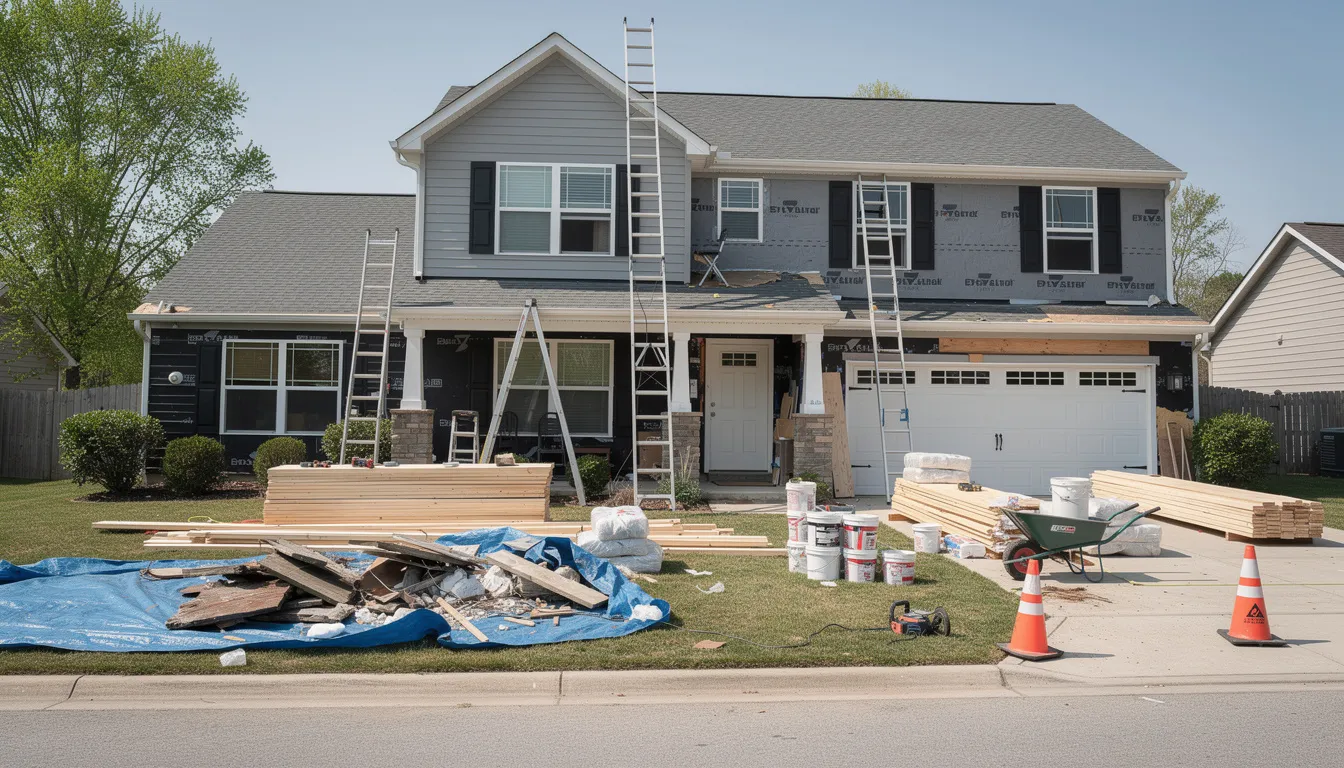
Fix and flip loans are short-term, interest-only financing products designed for investors who buy distressed properties, renovate them, and resell quickly. These are not rental loans, but they are essential for anyone executing value-add strategies before converting to long-term holds.
Typical fix and flip loan structures include:
* 6 to 18 month terms (12 months is most common)
* Interest-only monthly payments with a balloon at maturity
* Up to 85%–90% of purchase price
* Up to 100% of rehab costs in some programs
* Total loan capped at 70%–75% of After-Repair Value (ARV)
These loans are often provided by private lenders and hard money lenders rather than traditional banks. The trade-off is speed and flexibility. Approvals can happen in 3 to 10 business days, and credit requirements are more forgiving than conventional mortgage standards.
Standard documentation for fix and flip loans includes:
Basic credit check (often 620+ minimum)
Experience review (number of completed flips)
Detailed project budget and scope of work
Contractor bids for major systems
ARV appraisal or broker price opinion
Pros:
Fast approvals and closings
Flexible underwriting based on deal economics
Rehab funds disbursed in draws as work completes
Available to newer investors (with lower leverage)
Cons:
Higher interest rates (often 10%–14%) plus origination points
Pressure to execute renovation and sale quickly
Double closing costs if refinancing into a rental loan
Balloon payment creates refinance or sale deadline
Example deal: An investor purchases a distressed property for $190,000 and budgets $60,000 in rehab. The target ARV is $340,000. A fix and flip lender provides 85% of purchase ($161,500) plus 100% of rehab ($60,000), totaling $221,500. This represents 65% of ARV, within the lender’s 70% cap. The investor brings roughly $38,500 to closing plus reserves.
BRRRR Financing Strategy (Buy, Rehab, Rent, Refinance, Repeat)
BRRRR is not a loan product. It is an investment strategy that stacks multiple financing types in sequence to recycle capital and build a rental portfolio efficiently.
The BRRRR method follows five steps:
1.Buy a property below market value (often distressed or poorly managed)
2. Rehab the property to increase value and rent potential
3. Rent to a qualified tenant to stabilize cash flow
4. Refinance at the new, higher appraised value. Conventional refinances require a new application, credit check, home appraisal, and closing costs. Refinancing can also increase total finance charges over the life of the loan. Existing FHA loans can be refinanced into new FHA mortgages, but investment properties financed with FHA loans have specific occupancy requirements for refinancing.
5. Repeat using the extracted equity for the next deal. Home Equity Loans and HELOCs allow investors to leverage the equity in their primary residence for down payments or new property purchases but have more stringent guidelines for investment properties. A home equity loan, which is a second mortgage, offers a lump sum at a fixed rate, but comes with the risk of foreclosure if payments are missed and borrowing limits based on available equity.
The financing sequence typically involves:
Phase 1: Acquire the property with a fix and flip loan, hard money loan, or private capital
Phase 2: After 6–12 months of seasoning (and completed rehab), refinance into a DSCR loan, portfolio loan, or conventional mortgage for investment property
Step-by-step example with numbers:
| Step | Amount |
|---|---|
| Purchase price | $180,000 |
| Rehab budget | $55,000 |
| Closing costs and holding | $15,000 |
| Total all-in cost | $250,000 |
| Post-rehab appraised value | $340,000 |
| Refinance LTV (75%) | $255,000 |
| Cash recovered | $5,000 (plus property retained) |
In this scenario, the investor recovers nearly all their capital while keeping a cash-flowing rental. The recovered funds roll into the next BRRRR purchase.
Lender expectations for BRRRR refinances in 2025 include:
*Minimum credit scores of 640–680 for most DSCR products
*Rent verification via lease or market rent schedule
*Proof of completed renovations (photos, permits, invoices)
*Title seasoning of 6–12 months before using new appraised value
*DSCR of 1.00+ (higher for better rates)
The biggest risks in BRRRR are appraisal shortfalls and rehab cost overruns. If the property appraises for $300,000 instead of $340,000, the investor cannot pull out as much capital, trapping funds in the deal. Conservative budgeting and realistic ARV estimates are essential.
Renovation Loans for Rental Properties
Renovation loans finance both the purchase (or refinance) of a property and the rehabilitation work in a single loan. This contrasts with using separate fix and flip financing followed by a take-out loan.
For investors, renovation loan options include:
*Non-QM investor rehab-to-rent products
*Portfolio lenders offering construction-to-permanent loans
*Some conventional-style renovation programs (though most Fannie Mae HomeStyle and similar products require owner occupancy)
Typical renovation loan terms:
| Feature | Typical Range |
|---|---|
| Maximum LTV (based on ARV) | 75%–80% |
| Interest during construction | Interest-only in most programs |
| Post-completion term | 30-year fixed or ARM |
| Draw disbursement | Based on inspection milestones |
| Documentation | Detailed budget, contractor bids, permits |
Rehab funds are escrowed at closing and released in draws as work is completed and inspected. This protects the lender but requires investors to manage cash flow between draw requests.
Ideal use cases for renovation loans:
Older properties needing major systems upgrades (roof, HVAC, plumbing)
Adding bedrooms, accessory dwelling units (ADUs), or other living space
Converting single family to small multifamily (where zoning allows)
Cosmetic and functional rehabs on properties that are unfinanceable in current condition
Example: An investor identifies a 1960s triplex listed for $320,000. The property needs $100,000 in work: new electrical, updated kitchens and baths, roof replacement, and exterior paint. A renovation lender offers 75% of the $520,000 ARV ($390,000) covering both acquisition and rehab. The investor brings $30,000 down plus reserves, avoids two closings, and converts to a 30-year fixed loan upon completion.
Bank Statement Loans for Self-Employed Investors
Bank statement loans are alternative documentation mortgages where lenders analyze 12 to 24 months of business or personal bank statements instead of tax returns. They solve a common problem: investors whose taxable income looks low due to legitimate business write-offs.
The underwriting approach works like this:
Lender collects 12 or 24 months of bank statements
Deposits are identified and averaged to estimate monthly income
An expense factor (typically 40%–60% for business accounts) is applied
Remaining amount is used as qualifying income for DTI calculations
Example: A business account shows average monthly deposits of $35,000. The lender applies a 50% expense factor, leaving $17,500 as monthly qualifying income. This figure is used to calculate debt to income ratio for the investment property loan.
Typical bank statement loan parameters:
10%–25% down payment (higher LTVs for stronger profiles)
Credit scores of 620–660 minimum
Loan amounts from $150,000 to $3,000,000+
Available for both primary residence and investment property
Non-QM structure (not sold to Fannie Mae or Freddie Mac)
Pros:
Uses actual cash flow rather than tax return net income
Available for investors with high write-offs
More flexible than conventional loans for self-employed borrowers
Cons:
Higher interest rates than conforming products
Larger reserves often required
Complex underwriting of deposit sources
May not work well for investors with multiple properties already leveraged
When should an investor choose a bank statement loan over a DSCR loan? It depends on which income stream is stronger. If the property’s rent comfortably covers the DSCR threshold, a DSCR loan avoids personal income scrutiny entirely. If the property’s DSCR is marginal but the investor has strong personal cash flow, a bank statement loan may achieve better terms or higher leverage.
Asset Based Loans for Rental Property Investors
Asset based loans shift the qualification focus from income documentation to the borrower’s assets. This category includes two main structures:
Collateral-driven investment loans where approval centers on the subject property’s value and rental income (overlaps significantly with DSCR and private lending)
Asset depletion or asset qualifier loans where large liquid asset balances are converted into a qualifying income figure
Asset depletion works by dividing total liquid assets by a set period (often 360 months for a 30-year term) to create a monthly income equivalent. An investor with $1,200,000 in retirement accounts and brokerage accounts would show $3,333 in monthly qualifying income under this method.
Typical asset based loan requirements:
Minimum liquid assets often $300,000 or higher
Strong credit score (680+ is common)
Lower maximum LTVs (60%–70%) due to non-traditional qualification
Subject property must be financeable (no major deferred maintenance)
Example: A retired investor with $2,000,000 in securities and minimal taxable income wants to purchase a $900,000 rental property. A conventional mortgage would reject them for insufficient income. An asset based loan qualifies them using asset depletion, closes at 65% LTV ($585,000 loan), and requires no W-2s or complex business tax returns.
Pros:
No traditional income or employment verification
Ideal for retired, high-net-worth, or passive-income investors
Can close faster than income-documented loans
Cons:
Conservative leverage (lower LTVs)
Market risk if pledged securities decline
Potential margin-call structures with some products
Higher rates and fees than conventional mortgage products
Ideal borrower profiles for asset based loans:
Retired investors with substantial investment accounts
High-net-worth individuals with minimal W-2 income
Investors between jobs or transitioning careers
Those who prefer not to document business income
Portfolio Loans for Multiple Properties
For investors who own or plan to acquire multiple properties, portfolio loans offer a flexible and efficient financing solution. Unlike conventional loans, which are typically limited to a single property, portfolio loans allow you to finance or refinance several properties under one loan agreement. This can simplify management, streamline monthly payments, and make it easier to scale your real estate portfolio.
Portfolio loans are often offered by banks or private lenders who keep the loans in-house rather than selling them to Fannie Mae or Freddie Mac. Because of this, lenders can customize the terms, interest rates, and repayment schedules to fit the investor’s needs. However, these loans usually require a larger down payment—often 25% or more—and may come with higher fees or interest rates compared to standard conventional loans.
These loans can be used to finance a variety of property types, including single family homes, condominiums, and small multifamily properties. For investors managing multiple properties, portfolio loans provide the flexibility to finance new acquisitions, refinance existing holdings, or consolidate several mortgages into a single payment. While the upfront costs may be higher, the convenience and scalability make portfolio loans a valuable tool for serious real estate investors.
Second Mortgage and HELOC Options
A second mortgage or home equity line of credit (HELOC) can be a powerful way for investment property owners to access additional funds. By leveraging the equity in an existing property, investors can secure a loan or revolving line of credit to finance renovations, repairs, or even the purchase of another investment property.
A second mortgage is a lump-sum loan that uses your existing property as collateral, while a HELOC functions more like a credit card, allowing you to borrow and repay funds as needed up to a set limit. Both options can provide quick access to cash, making them ideal for investors who need to act fast on new opportunities or cover unexpected expenses.
It’s important to note that second mortgages and HELOCs often come with higher interest rates and fees than primary mortgages, reflecting the increased risk to the lender. However, for investors with significant equity in their properties, these financing tools can offer the flexibility to fund improvements, expand their portfolio, or bridge the gap between other loan options. As with any investment property financing, careful planning and a clear repayment strategy are essential to ensure long-term success.
Choosing the Right Investment Rental Property Loan Type
Matching the right loan to your situation requires evaluating your investment goal, property condition, and documentation strength.
Common investor profiles and recommended loan types:
| Investor Type | Best Loan Options |
|---|---|
| W-2 employee buying first rental | Conventional loans, DSCR loans |
| Self-employed landlord with tax write-offs | DSCR loans, Bank statement loans |
| Full-time flipper | Fix and flip loans, Hard money loans |
| BRRRR strategist | Fix and flip (acquisition) → DSCR (refinance) |
| High-net-worth, low-income investor | Asset based loans, DSCR loans |
| Buying distressed or heavy-rehab property | Renovation loans, Fix and flip loans |
Decision framework:
Start with your goal: Are you holding for passive income or flipping for profit?
Assess property condition: Turnkey rentals qualify for DSCR; heavy rehabs need renovation or fix and flip financing
Evaluate documentation strength: W-2 income supports conventional; bank statements work for self-employed; DSCR uses property cash flow; asset-based uses liquid wealth
When comparing loan options, look beyond the nominal interest rate. Consider:
Origination points and closing costs
Prepayment penalties and their structure
Speed of closing (critical for competitive markets)
Reserve requirements
Seasoning requirements for future refinances
There are a variety of investment products available for real estate investors, including jumbo loans for high-value properties, interest-only mortgages that can help manage cash flow, and specialized investment-related loans tailored for purchase or refinance of investment properties. Each product comes with its own terms and restrictions, so it’s important to match the loan type to your investment strategy.
Before applying, gather a recent credit score, 12–24 months of bank statements, a basic deal pro forma showing purchase price and expected rents, and speak with at least two or three lenders who specialize in investment property financing.
Finding the best investment rental property loans starts with understanding how lenders view an investment property compared to a primary mortgage. Loans used to purchase a rental property, vacation home, or other non primary residence typically require a higher down payment and come with stricter requirements than financing for an owner-occupied home. Using a smaller down payment may increase your cash-on-cash return but also increases risk. Conventional loans are often a strong option for single family homes, one unit properties, or properties with up to four units, as long as the borrower maintains a higher credit score and an acceptable debt to income ratio. These loans usually offer lower fees, more predictable mortgage payments, and more favorable terms than many non conventional loans. Because the property is considered a non primary home, lenders carefully evaluate the mortgage application, the borrower’s ability to manage the payment, and the overall property type before approving the mortgage loan.
When considering government-backed loans, note that VA and FHA loans are generally not available for investment properties unless the borrower occupies one of the units as a primary residence.
For real estate investors expanding into additional property acquisitions, non conventional loans, private lenders, and other loans can provide flexibility that traditional financing cannot. These options are commonly used for real estate investment involving an existing property, commercial real estate, or situations where investors want to access equity through a cash out refinance, second mortgage, or home equity line tied to a primary mortgage. For properties with five units or more, commercial real estate loans apply and have stricter qualification processes compared to residential loans. While these forms of real estate finance may carry a higher interest rate, they often allow financing to close in a timely manner and can be structured around property income rather than personal income alone. Whether financing one unit, other units, or multiple single family properties, choosing the right mortgage structure and payment plan is critical to long-term success in real estate investment and building a sustainable investment portfolio.
Key Underwriting Requirements and How to Prepare
Documentation requirements vary by loan type, but most investment property lenders will request:
- Government-issued ID
- Credit report authorization
- 2–3 months of recent bank statements (or 12–24 months for bank statement loans)
- Property pro forma with purchase price, estimated rents, taxes, and insurance
- Existing mortgage statements for other owned properties
- Leases for any current rental property holdings
- Entity documents if borrowing through an LLC
- Scope of work and contractor bids for rehab projects
Minimum credit score requirements by loan type:
| Loan Type | Typical Minimum Credit Score |
|---|---|
| Conventional mortgage | 680+ for investment property |
| DSCR loans | 620–660 |
| Fix and flip loans | 620–640 |
| Bank statement loans | 620–660 |
| Asset based loans | 680+ |
| Renovation loans | 640–680 |
Pre-application checklist:
Pull your own credit report and dispute any errors
Pay down revolving credit card balances below 30% utilization
Season cash in your accounts for at least 60 days (no unexplained large deposits)
Document past flip or landlord experience with photos, settlement statements, and addresses
Prepare a one-page deal summary showing purchase price, rehab budget (if any), expected rent, and target DSCR
Risks, Costs, and Exit Strategies
Every investment property loan carries risks beyond simply paying higher interest. Before signing, understand:
Variable rates: ARM products can reset higher, squeezing cash flow
Balloon payments: Fix and flip and some portfolio loans require full payoff at maturity
Rehab overruns: Underestimating renovation costs eats into equity and can prevent refinance
Appraisal risk: If ARV comes in low, BRRRR strategies fail to recycle capital
Prepayment penalties: Yield-maintenance or step-down structures can cost thousands if you sell or refinance early

Clear exit strategies are non-negotiable when using short-term or high-cost debt. Before closing any loan, define whether you intend to:
Sell the property after renovation
Refinance into a long-term hold loan
Hold and pay off the existing mortgage over time
Each path should be stress-tested. What happens if the after-repair value comes in 10% lower than projected? What if it takes 90 days longer to rent or sell? What if rates are 1% higher when you go to refinance?
Questions to answer before signing any investment property loan:
What is my all-in cost including points, fees, and closing costs?
What is my realistic exit timeline?
Can I still refinance or sell profitably if ARV drops 10%?
Do I have enough cash reserves to cover holding costs if the project takes 90 days longer?
What is the prepayment penalty if I exit early?
Building a rental portfolio with DSCR, fix and flip, BRRRR, renovation, bank statement, and asset based loans is a powerful wealth-building strategy. But discipline matters. Conservative leverage, realistic projections, and multiple exit options protect you when markets shift.
Start by organizing your documentation, running the numbers on your target property, and speaking with lenders who specialize in investment property loan requirements. The right financing turns a good deal into a great one.